FeaturePatterns
It tells you how sure it is.
After a few weeks your log knows things you don’t. Patterns reads it and says what stands out, and every finding says what it is: something that happened, an early sign, or a pattern that has earned the word.
- Graded, every time
- Observation, early sign or pattern
- 30 days for a pattern
- And a false-discovery check across everything
- Associations, not causes
- Said on the page, not in small print
- Free
- Highlights and their grades
01Highlights
What stands out in this range
Five cards, not fifty charts.
Open Patterns and a drawer of Highlights rises over the body: at most five cards, the strongest first. Each is one sentence in plain words, with its grade above it and its evidence under it.
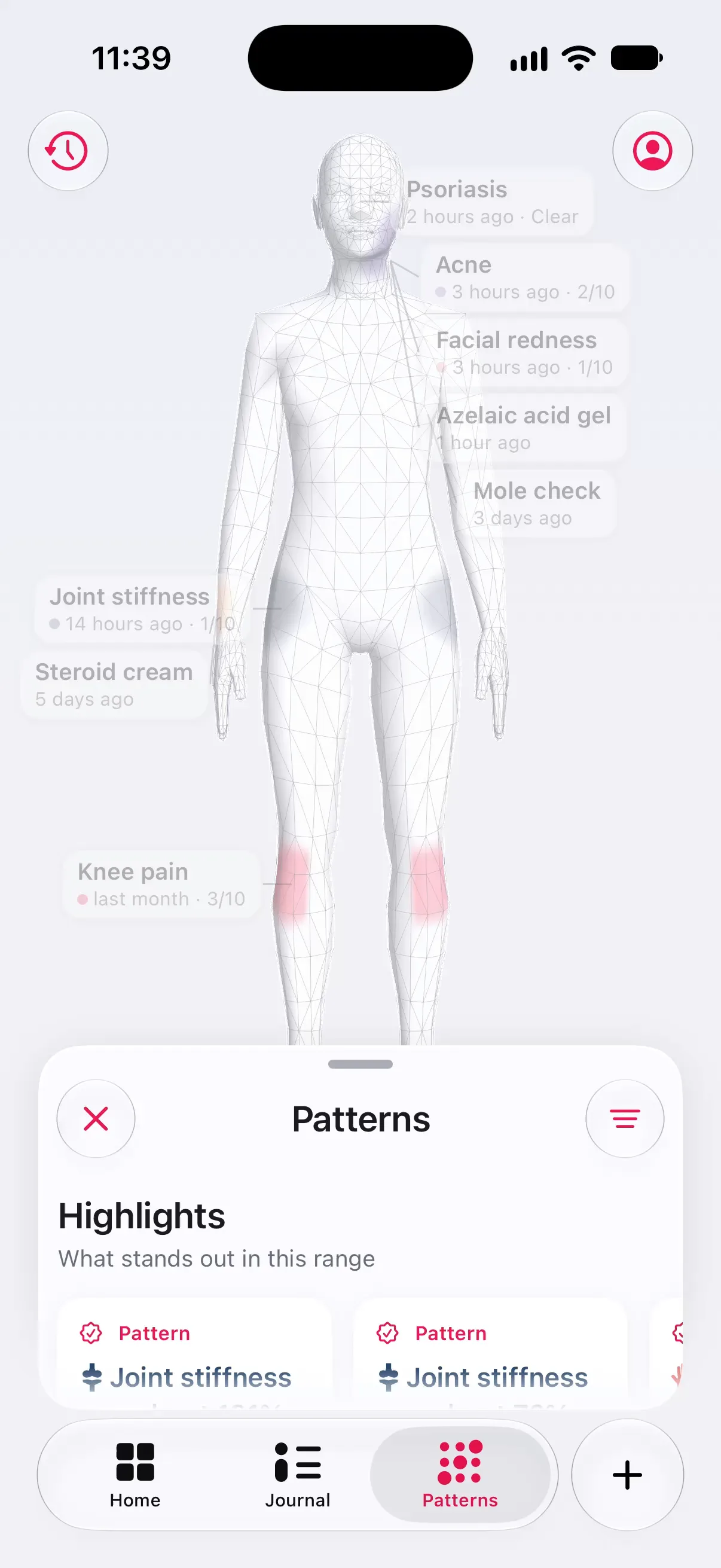
- 01Patterns by the hour first: how a symptom moves in the hours after a dose, “Joint stiffness was about 23% milder 1–4 h after you took Ibuprofen”, once there are enough doses to say so.
- 02Then patterns between days: two trackers that move together, on the same day or up to three days apart.
- 03At most one early sign at a time, so a hunch never crowds out what is known.
- 04Then observations about a tracker on its own: “On 18 of 30 logged days”, or its average against the span before.
02How sure
Four standings, weakest first
A pattern has to earn the word.
Compare enough things and some will line up by chance. So the app counts how many comparisons it made, and only a link that survives that check across all of them is called a pattern.
- Observation
A fact about one tracker’s own entries: “On 18 of 30 logged days”. It cannot be wrong, and it claims nothing about why.
- Hint
A possible link where one side of the comparison has only 3 or 4 days. Shown only in browsing lists, like the weather sheet and Moves with it, with both counts. Never in Highlights or the report.
- Early sign
A possible link between two things, worded as a hunch with its day count. Same day or next day only. Highlights show at most one at a time.
- Pattern
A link that survived a false-discovery check across everything the app compared, and still points the same way in the range on screen.
How strong
A pattern says how closely the two move: a weak, moderate or strong link, with the days behind it.
How much evidence
Limited, fair or good evidence, from the number of days and whether the link holds when the timing shifts. Limited evidence is never called strong.
Still true now
A pattern must still point the same way in the range on screen, or it is not shown.
03What it reads
Your entries, and nothing else
Everything you log is a question it can ask.
There is no list of suspects to fill in. Every tracker is compared with every other, and the things you mark become factors of their own.
Sleep and fatigue, coffee and migraine, a treatment and the symptom it is for: the same day, or one to three days later.
Each option of a choice measure, like a food or a trigger you tick, is checked as its own factor once there are enough days with and without it.
With Pro weather, days when the air pressure fell 3 hPa or more, and rainy days, are compared with the rest.
Everything is computed on your iPhone from your own entries. They are never sent anywhere to be analysed.
04Look closer
Pro
See exactly what a finding stands on.
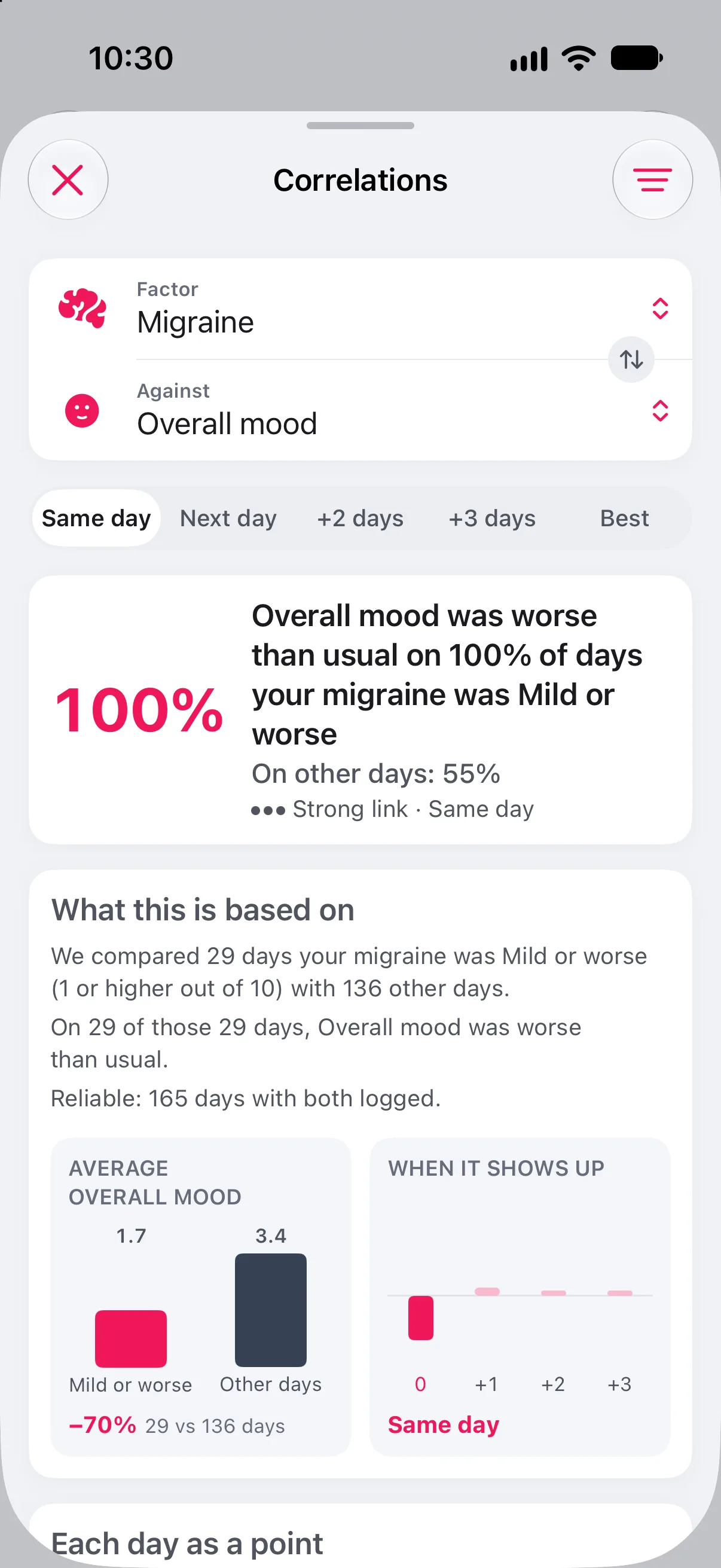
With Pro, tap a Highlight and it opens with what it is based on: the two averages, with and without, the days on each side, and how the link changes when one is shifted a day or more.
- 01Compare two trackers on one timeline.
- 02Correlations: how any two move together, the same day or up to three days apart.
- 03Heatmap: months of one tracker at a glance.
- 04What moves it: the factors most linked to one tracker, ranked.
Your say
Each finding you open ends by asking whether it rings true for you. You know things your log doesn’t.
05Honest by design
What it will not say
Never a cause. Never advice.
A link in your log is a reason to look closer, or to bring it to an appointment. It is not proof, and the app says so where you read it.
Under the Highlights, every time: Patterns are associations, not causes.
When one is shown, the page adds that early signs need more days and often fade. Many do.
With too little data, Patterns says No patterns yet
rather than inventing one.
06Read next
Blog · Guides
More on reading your own data.
07Explore more
Features
The rest of the note.
 Body atlas
  Quick log
  Journal
  Summary
 Let the weeks add up.
Free to download, free to keep. Highlights and their grades are free, and the analysis never leaves your iPhone.